Month: October 2010

  • Christians respond to suffering #4

    “… Shall we indeed accept good from God, and shall we not accept adversity?…” Job 2:10

     Mr Paul Cavanough (Director of Ministry, Anglican Diocese of Tasmania) and Mr Greg Foot share their thoughts on the questions of Why is there suffering? And, if there is a God who is supposed to be loving and all-powerful, then why does He allow suffering?

     After decades of answering this question in schools ministry I got down to, “God knows these things happen and they make him sad and angry. He has directed his Christian people and all men and women of good will to bring relief, care, justice and love into disastrous situations. The Church is God’s love in action. That’s God’s plan of action for today but he also has a day planned when all the grief and injustice will come to an end forever.

     Summary: God knows – He acts through his people – It won’t go on forever.

     – Mr Paul Cavanough

    Suffering isn’t necessarily pointless just because it appears to be. Why should there not be a purpose behind all suffering from God’s eye view that we cannot see? (Genesis 45:1-8, John 9:1-12)

    The fact that there is suffering leads us to think about why we see some things as ‘good’ and others as ‘evil – an extra-natural moral standard. Atheism cannot give us many answers to this, but Christianity can give us plenty (Genesis 3).

    God knows all about suffering – His Son was crucified.

    – Mr Greg Foot

     See also Answering the problem of suffering and Christians respond to suffering #1 and Christians responding  suffering #2 and Christians respond to suffering #3

  • Christians respond to suffering #3

    “… Shall we indeed accept good from God, and shall we not accept adversity?…” Job 2:10

     The Very Revd Richard Humphrey (Dean of St David’s Cathedral) shares his thoughts on the questions of Why is there suffering? And, if there is a God who is supposed to be loving and all-powerful, then why does He allow suffering?

     Yancey handles this well in his two books, ‘Where is God when it hurts?’ and ‘Disappointment with God.’

     Without wanting to go into a philosophical issue of causality, free will etc, I will go for my emotional response.

    The very fact that we respond to suffering the way we do says something.  When we experience grief it is a real experience and that this matters.

     But if there is no God then this feeling is only an illusion and it does not matter as we are only a random collection of atoms and accidents.  The grief I feel is not real, it is only a chemical reaction.  But the problem is we know it is real we may not be able to prove it but we know, and this sense of things not being as they should be only makes sense if there is a God who has determined what is right and wrong.  I do not have enough faith to go against this evidence.

     The book of Job then calls on us to trust God in the moral sphere as we trust him in the creative sphere, to use David Clines remarkable phrase “innocent suffering is a hippopotamus.” Just as we don’t understand a hippo, what it is for, we should trust God.

     Why, ultimately because he entered into that suffering. And triumphed over it. Thus whilst creation groans it will be redeemed.

     Ecclesiastes would add that as humans we simply can’t see things from God’s perspective so it is all ‘hebel’ (vanity), mist, ungraspable.

     It’s not much of an answer, but I think it is worth saying that I am a Christian not because I understand suffering, but because of Jesus and in him I have the best hope of an answer.

     See also Answering the problem of suffering and Christians respond to suffering #1 and Christians respond to suffering #2


  • Christians respond to suffering #2

    “… Shall we indeed accept good from God, and shall we not accept adversity?…” Job 2:10

     I continue on my quest to discover how other Christians respond to the questions Why is there suffering? And, if there is a God who is supposed to be loving and all-powerful, then why does He allow suffering?

     Some thoughts by Revd Matt Gray (Chaplain at The Hutchins School),

    This is often treated as the most curly question. The full weight of the question should be allowed to hit – so if the question is asked in soft form i.e. why does God allow sickness – I would intensify it by an example. I watched recently the 9 hour 1985 documentary SHOAH – the Holocaust survivors being interviewed. A delightful smiling man breaks down explaining that he had to bury the bodies of his wife and children on his first day in the camp. He stood in the middle of the pit where they lay and pleaded with a Nazi soldier to shoot him. I would remind the inquirer of the great depth of the question of suffering.

    Then I would suggest that one could be forgiven for thinking that our scriptures were actually designed to answer that question. From the Fall, the suffering of Joseph (Genesis 50:20), Israel in Egypt, the desert wanderings, the entire book of Job, the relentless testimony of the Psalmist, the practical wisdom of the Proverbs re: avoiding strife, the lament of the Prophets, the response of God to suffering in the person of His Son in the Gospels, the repeated epistolary response such as Romans 8 and 1 Peter 1, to the last words in Revelation (the latter can be described as  a response to suffering of the early Christian Church.) Most significantly, the depths of suffering and the answer to all grief come together in the one moment at Calvary. Suffering intertwines with salvation in Christian (and Jewish) understanding.

    We often take a back foot approach that suggests that suffering is a weakness for Christian apologists to explain. I think it is definitely a front foot issue. The scriptures are full of great encouragement to the suffered, – our opponents can only explain “Don’t worry, you are an insignificant parcel of atoms and there is no rhyme or reason for your suffering in this blind, haphazard universe.” Where can the sufferer look for hope?

     See also Answering the problem of suffering and Christians respond to suffering #1.

  • Christians respond to suffering #1

    “… Shall we indeed accept good from God, and shall we not accept adversity?…” Job 2:10

     In a recent post, Answering the Problem of Suffering, I looked at the two most common questions I am asked, why is there suffering? And, if there is a God who is supposed to be loving and all-powerful, then why does He allow suffering?

     I have asked some friends for their thoughts to these questions which will be posted in a series of blogs entitled Christians responding to suffering.

     Some thoughts from James Veltmeyer

     1.    When people ask about suffering, think why they are asking, e.g. “Why does God let people die of cancer?”

    That is, “Why did God let my dad die of cancer?”

    People understand that people die of things like cancer and they want to know why a certain person they love has it.

    Sometimes I say no matter what answer I give it won’t fix their problem of suffering. But I can be there for them and just listen.

     2.    There is suffering because we live in a fallen & broken world.

     3.    We suffer because of people’s sin.

    If a person who is drunk drives a car and hits my brother and kills him then it was the person’s choice or sin that caused my suffering.

    God gave us free will, a choice to live for Him or live for ourselves.

     4.    Suffering shows there is a God

     Haiti – “How can God allow this?” – see point 2.

    For the atheist it’s just the way life is they can’t give a person who is suffering any comfort. Atheism doesn’t answer the problem of suffering.

    When we cry out “Why” – who are we crying out to??? Maybe God

    When we want someone to do something – maybe it’s God that we want to do something

    Also maybe God is restraining or holding back suffering, the suffering could have been worse but in God’s mercy it isn’t.

     5.    Suffering causes us to repent and trust Jesus – see Luke 13:1-9

     6.    God understands our suffering, He sent His Son Jesus to suffer, die on a cross and rise again.

     7.    Suffering will one day stop. The hope of Heaven – see Revelation 21:4, no more suffering. A great promise for Christians.


  • No Holy Books 4 new Aussies

    Praise God for Senator Guy Barnett who is protesting the ban on Bibles being offered as gifts at citizenship ceremonies. See, Barnett fights Bible ban.  

    Hobart and Clarence councils this year stopped handing out Bibles after they were told by immigration officials they were no longer needed.

    Liberal senator Guy Barnett said the move was “political correctness gone mad”.

    Clarence mayor Jock Campbell said his council had been told by the Department of Immigration and Citizenship that if citizenship candidates wanted to swear an oath on a holy book, they needed to bring their own.

    Hobart Lord Mayor Rob Valentine said his council began advising candidates this year they needed to bring their own.

    “We were told by immigration, quite some time ago, not to give Bibles out anymore,” Ald Valentine said.

    Ald Campbell said until this year Bibles supplied by the Bible Society of Australia had been handed out to participants who opted for the Christian oath. “I’d see it as an unnecessary change,” he said.

    See article, Row over Bible handouts.

     Apparently in 2003 the Department of Immigration and Citizenship decided against giving holy books at citizenship ceremonies but it is only now being implemented – in Tasmania!

    Senator Barnett has called on the Immigration Minister Chris Bowen to make a ruling. Pray the Minister rules rightly.

  • Answering ‘the problem’ of suffering

    “… Shall we indeed accept good from God, and shall we not accept adversity?…” Job 2:10

     This was Job’s response to his wife after his property was destroyed, his children killed and his own health was attacked.

     Two of the most common questions I am asked is why is there suffering? And, if there is a God who is supposed to be loving and all-powerful, then why does He allow suffering?

     The problem of suffering was raised in recent blogs I wrote:

     Ken Sande in his book “The Peacemaker: A Biblical guide to resolving conflict,” says that even though God does not take pleasure in hurtful events and is not the author of sin,

     Yet, for his eternal purposes, he sometimes allows suffering and permits unjust acts by men and women when he decides not to restrain, even though he has the power to do so…Even when sinful and painful things are happening, God is somehow exercising ultimate control and working things out for his good purposes… Knowing that he has personally tailored the events of our lives and is looking out for us at every moment should dramatically affect the way we respond to conflict.

     Hence God does not insulate us from suffering, but is with us in our suffering and accomplishes good through it. When we suffer insults, conflicts, hardships – God teaches us we need to rely on Him. When we suffer the consequences of our sins – God teaches us we need to repent. When we go through difficulties – God uses this to conform us to the likeness of Christ. – From my blog “Peace, conflict and grace.”

     Ajith Fernando, in his article “To serve is to suffer” also looks at the reality that if you are Christian who seeks to witness for the gospel of Christ (particularly in ministry) you will endure suffering.

      In a world where physical health, appearance, and convenience have gained almost idolatrous prominence, God may be calling Christians to demonstrate the glory of the gospel by being joyful and content while enduring pain and hardship. People who are unfulfilled after pursuing things that do not satisfy may be astonished to see Christians who are joyful and content after depriving themselves for the gospel. This may be a new way to demonstrate the glory of the gospel to this hedonistic culture. – From my blog “To serve is to suffer!”

    I have asked some ‘guest bloggers’ to contribute to this issue and their articles will appear in the coming days.

  • Susan Boyle: Docs said ‘abort’

     From LifeSiteNews.com, October 15 a frightening revelation: “International singing phenomenon Susan Boyle has revealed in a new autobiography that doctors had told her mother to abort her, because they thought the pregnancy was risky.

    Boyle soared to stardom in April 2009 after appearing on the UK television program, Britain’s Got Talent, when the plain-looking Scotswoman shocked audiences with a powerful rendition of “I Dreamed a Dream” from the musical version of Victor Hugo’s Les Misérables.

    But the 49-year-old native of Blackburn, a village in West Lothian, Scotland would never have dreamed the dream of singing on the international stage, if her mother had agreed to abort her on the advice of doctors.
      
    In her autobiography, The Woman I Was Born To Be, Boyle reveals that doctors recommended a “termination” to Bridget Boyle, who already was a mother of eight children, because they feared physical complications.

    Boyle reveals that her mother rejected this advice as “unthinkable” since she was a “devout Catholic.”

    When Boyle was born by emergency c-section, doctors did not tell her mother the usual “Congratulations, Mrs. Boyle! A beautiful baby girl.” Boyle wrote that doctors took a dismissive view of her life – especially when they suspected brain damage due to oxygen deprivation.

     “‘It’s probably best to accept Susan will never be anything,” Boyle recounted the doctors telling her mother. “‘Susan will never come to anything so don’t expect too much of her.’”

    “I’m sure they had the best of intentions,” Boyle continued, “but I don’t think they should have said that, because nobody can foretell the future.”

    This article with links at, Susan Boyle: Docs Told Mum to Abort Me.   Also, ‘a mini opera of underdog triumph’

  • Art & Gospel of Christ

    As an enthusiast of Christian art I am excited by the recent October issue of the Tasmanian Anglican.

    The magazine features the artwork of two Christian ladies who are using their art in the community to preach the gospel of Jesus Christ.

    The story of Paintings & Written Reflections on Biblical Texts features artwork by Maz Gill-Harper from her recently published book Parables of Jesus of Nazareth. One of her paintings, The Sower, appears on the front cover of the magazine.

    Michael Frost from Morling College, Sydney, says in his Foreword to the book,

    These earthy stories are accessible to the least sophisticated audience…Throughout history, some religious scholars have over-thought the parables, searching too hard for allegory, or finding esoteric meanings never intended by Jesus himself.

    The parables are what they are, simple stories that subversively sketch an alternate world, a world brought to earth by Jesus, a world into which we step when we embrace Jesus’ vision and embrace his kingship.

     The Sower, from “Parables of Jesus of Nazareth’” by Maz Gill-Harper. Used with kind permission

    Sculpture – ‘God has made a way’ tells of artist Rebecca Brogan’s sculpture that was rejected from two exhibitions for being too religious. Through prayer, it was finally accepted at a third exhibition, and a very happy appreciator of recycling junk and artwork (aka my wife) obtained it for outreach events.

    Rebecca says of her sculpture (a Cross made from recycled materials of wood, garbage and barbed wire), 

    Two-thousand years ago, Jesus Christ was rejected and treated as refuse by some while others laid down their lives out of their great love for him. Today some people still view him as a load of rubbish, but to me, he is of inestimable worth.

    This is why:

    ‘God made him [Jesus] who had no sin to be sin for us, so that in him we might become the righteousness of God.’ (2 Corinthians 5:20 NIV-The Bible) Jesus, though he was sinlessly perfect, took upon himself all of my sinful garbage and bore the full punishment for it by dying on the cross in my place. Then, as a free gift received in faith, he forgave me and imputed his perfect right standing with God unto me.’

    This sculpture conveys the revolting sin of mankind, which Christ ‘became’ on our behalf. This was his expressed purpose in coming into the world, to bear the punishment for our sin and reconcile us back to God.

     Read the rest of the article, Paintings & Written Reflections on Biblical Texts, and  Sculpture – ‘God has made a way’. Praise the Creator of the universe for Christian artists!

  • Advance Care Planning

    I have been asked about the merit of doing an Advance Directive or Advance Care Planning. This seems an excellent way of deciding the extent of medical intervention you want should you become sick and unable to communicate. This is not euthanasia as there is no intervention with the intent to kill but rather the decision to nolonger receive medical treatment. This is consistent with a Christian understanding of life and death.

     I have been directed to two excellent resources on Advance Care Planning by my good friend and Medical Advisor Dr Philip Thomson.

     The first resource, Enduring Guardianship defines an enduring guardian as

    a person you appoint to make your personal or medical decisions if you should lose the ability to decide for yourself because of a disability.

    The infosheet goes on to explain further what an enduring guardian is, what decisions they can make, conditions you can set, who you can appoint, and other important factors to consider before taking this step.

    The Enduring Guardianship infosheet can be downloaded here.

    The second resource, Advance Care Plan says that

    Advance care planning is about the promotion of autonomy and dignity and not about euthanasia or suicide.

    The information sheet defines further Advance Care Planning, Enduring Guardianship, documenting your wishes, completing a plan and how to change or revoke your plan.

     The Advance Care Plan information sheet can be downloaded here.

    Please also note the comments about planning for dying between John Tongue and myself in the comments at the end of Euthanizing Fear?.

  • ‘Tasmanian Anglican’ – October

    In the October issue of the Tasmanian Anglican, which is now available online, I share some stories from my Prayer Pilgrimage around Tasmania.

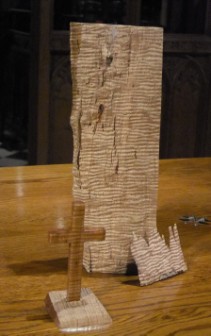
    In Just another log, I speak of the special gift I received of a piece of prose entitled Fiddleback, and three pieces of wood:

    I started out on a wood heap. Really, just like any other firewood log. Nothing very special, just a bit of local ‘ironbark.’ It was only when split that my tortured years were revealed and the slow and stunted growth that caused my grain to be so contorted was first seen in the light of day.

    It’s peculiar sometimes things of such unsightliness are missed for their true potential. With some care, all those hard years can be transformed into a thing of beauty, when planed, sanded, stained and polished. But even then, the hard years can still be seen.

    You have to look intently and at just the right angle, and then you can see the highs and lows, they are quite plain, just beneath the surface, a reflection of the past. It’s a sort of parallel to a human life being transformed by the gracious hand of God. What was and now is.

    It’s a bit like ahealthychurch…transforminglife.

    In The centre of Tasmania, Latitude 42.1, I share how David Morrison, Chris Sadler and I spent 15-20 minutes praying on a very cold day with beanies and jackets around a stone monument in the middle of nowhere. David led in reading the verses from Isaiah 42:1-12. The Lord burdened me to pray that Tasmania, shaped like a heart, would beat with the heartbeat of Christ.

    In The shepherd’s crook, the lantern and a purple chicken, I speak of the symbol of my ministry as Bishop, the shepherd’s crook, which reflects my role to shepherd God’s people and my responsibility to live and teach the message of Jesus Christ, the light, who has come into the world. The second symbol I took was a light. As I lit the candle and placed it in the lantern it reminded me that Jesus said ‘I am the light of the world.’

    The pilgrimage was also a time of ongoing learning as I learnt about chickenfeed, the purple chicken card and of course the purple chicken.

    Read these stories and more in the ‘Tasmanian Anglican’ October 2010 magazine here.